
Roofing system 02
Standing Seam Metal Roofing
Continuous steel panels from eave to ridge, joined by raised seams with the fasteners hidden underneath.
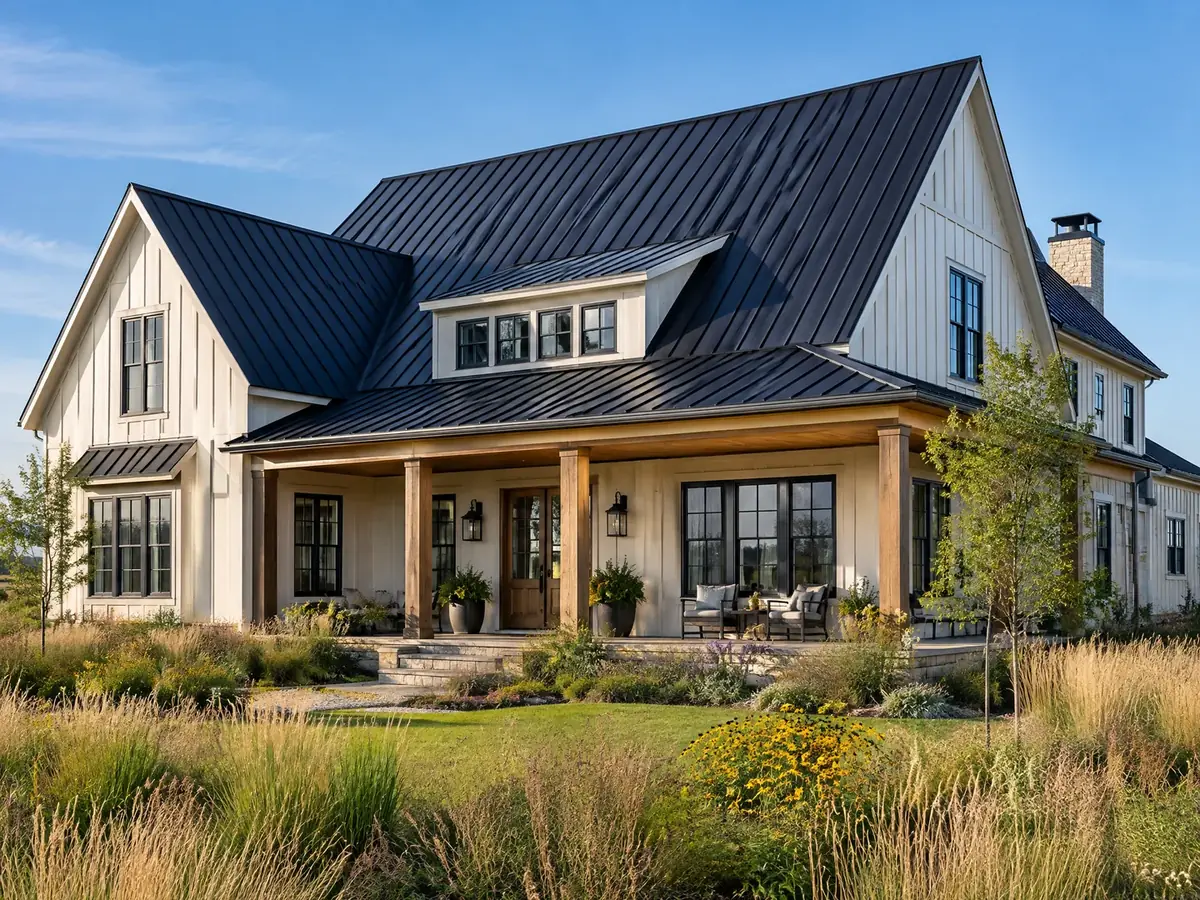
Standing Seam Metal Roofing uses continuous steel panels that run from eave to ridge and lock together at raised seams, with clips and fasteners concealed under the seam. Bishop's Metal Roofing installs it on Missouri and Illinois homes with long, simple roof planes, modern or farmhouse styling and low-slope sections, backed by a stated 50-year warranty.
- Fasteners
- ConcealedClips under the seam
- Seam height
- About 1–2 inProfile-dependent
- Code minimum
- 1/4:12IRC R905.10.2; panel listing governs
- Warranty
- 50-yearStated; written terms control
What it is
What is a standing seam metal roof?
A standing seam roof is made of long steel panels, usually 12 to 18 inches wide, that run in one piece from the eave to the ridge. The edges of neighboring panels rise into a seam that locks together above the water line. Panels are held to the deck by clips hidden inside that seam, so there are no exposed screws through the face of the roof[1][2].
That concealed-fastener design is the main difference from exposed-fastener panels used on barns and outbuildings, which rely on hundreds of rubber-washered screws through the panel. Bishop's installs only concealed-fastener Standing Seam on homes.
Seams
Snap-lock or mechanically seamed: which seam do you need?
The seam type is chosen from the roof's slope, length and exposure, and the panel's own listing.
| Seam type | How it closes | Where it fits |
|---|---|---|
| Snap-lock | Panels snap together over the clip; no field seaming tool | Steeper residential roofs, most re-roofs, shorter runs |
| Mechanically seamed (single or double lock) | A seaming tool folds the seam closed on the roof | Lower slopes, longer panel runs, higher wind or snow exposure |
| Fixed vs. floating clips | Floating clips let long panels expand and contract | Long runs where thermal movement must be allowed[2] |
Best fit
Which homes are a good fit for standing seam?
Standing Seam suits roofs with long, clean planes: modern farmhouses, contemporary homes, lake houses, porches and additions. It is also the right metal system for lower-slope sections where shingles of any kind are not allowed. The building code permits standing seam systems down to 1/4:12, though each panel's tested listing sets the real minimum for that product[3].
Steel panels shed snow quickly, which is good for the roof and a planning item for everything below it. On Missouri and Illinois homes we lay out snow retention over entries, walkways, decks and lower roofs as part of the design, not as an afterthought[4][5].
- Long, simple roof planes and modern or farmhouse architecture
- Low-slope porches, additions and transitions (within the panel's listing)
- Homes planning solar: seam clamps attach without penetrating the panel[1]
- Owners who want the cleanest lines and fewest exposed parts
Finish
How do finishes and colors affect a standing seam roof?
Most residential standing seam steel is finished with either a PVDF (often sold as Kynar 500) or an SMP (silicone-modified polyester) paint system. PVDF finishes generally hold color and resist chalking longer, while SMP costs less; the paint warranty is usually separate from the panel warranty, so read both.
Lighter colors and pigments rated for solar reflectance keep the roof surface cooler in summer. ENERGY STAR lists qualifying reflective roofing products if summer cooling matters to you[6].
Installation
How do we install a standing seam roof?
The panel is only as good as the deck, underlayment and trim under and around it.
- Tear-off and deck repair
Remove old layers, replace damaged decking and make sure the deck is flat enough that panels do not telegraph waves.
- High-temperature underlayment
Ice barrier where required at eaves and valleys, with high-temperature underlayment rated for use under metal[3][7].
- Trim and flashing
Eave, rake, valley and wall flashings are formed and set before panels so water always laps over, not under.
- Panels and clips
Panels are cut to length, set square, and clipped at the spacing the manufacturer specifies for the wind exposure[2].
- Seaming, ridge and snow retention
Seams are closed, the ridge is vented and capped, and snow retention is clamped to the seams where planned[4].
- Walkthrough and documents
A final inspection with you and the written warranty and closeout package.
Compare
Standing seam or stone-coated steel: which should you choose?
Standing Seam wins on clean lines, low slopes and solar mounting. Stone-Coated Steel wins on complex traditional roofs and shingle-look neighborhoods.
| Factor | Stone-Coated Steel Shingles | Standing Seam Metal Roofing |
|---|---|---|
| What it is | Formed steel panels coated with bonded stone granules, shaped to look like shingles, shake or tile | Long vertical steel panels joined by raised seams, with fasteners concealed under the seam |
| Look | Traditional texture; reads like an architectural shingle or shake from the street | Clean vertical lines; modern, farmhouse and lake-home styles |
| Best roof shapes | Pitched roofs with hips, valleys and dormers | Long, simple planes, porches and lower-slope sections |
| Minimum slope (IRC) | 3:12 for metal roof shingles (R905.4.2) | 1/4:12 for standing seam systems (R905.10.2) |
| Snow behavior | Granule texture holds snow longer, so it slides less suddenly | Smooth panels shed snow fast; plan snow retention above entries |
| Hail | Many products carry UL 2218 Class 4 impact ratings; granules mask minor dents | Class 4 ratings available on many panels; thicker gauges resist cosmetic dents better |
| HOA fit | Usually approved where shingle appearance is required | Check architectural rules before ordering |
FAQ
Standing Seam Metal Roofing: common questions
Is standing seam a hidden-fastener metal roof?
Yes. The clips that hold standing seam panels to the deck sit inside the raised seam, so no fasteners penetrate the face of the panel.
Can standing seam be installed on a low-slope roof?
Often, yes. The code allows standing seam systems down to 1/4:12, but each panel's listing sets its own minimum. Mechanically seamed panels are typically used on the lowest slopes.
Do I need snow guards on a standing seam roof?
On most Missouri and Illinois homes, yes, at least above entries, walkways, decks and lower roofs. Smooth steel panels shed snow quickly, and snow retention controls where and how it releases.
Can solar panels go on a standing seam roof?
Yes. Clamps attach solar racking directly to the seams without drilling through the panel, which is one reason standing seam is popular with solar owners.
What is oil canning on a standing seam roof?
Oil canning is visible waviness in the flat part of a panel. It is mostly cosmetic. A flat deck, the right gauge, and panels with striations or pencil ribs reduce it.
What warranty does Bishop's offer on standing seam?
Bishop's states a 50-year warranty. The written documents for your panel, finish and installation define the actual coverage and are provided before you sign.
References
Sources
- Metal Roofs (Building America Solution Center) — Pacific Northwest National Laboratory
- Standing Seam Roof Clips Best Practices — Metal Construction Association
- 2021 International Residential Code, Chapter 9: Roof Assemblies — International Code Council
- Qualifying Snow Retention Systems for Metal Roofing — Metal Construction Association
- Preventing Roof Ice Dams — National Weather Service
- Cool Roofs — ENERGY STAR
- Roof Guide: Codes & Standards — Insurance Institute for Business & Home Safety
Consultation
Schedule Your Roofing Consultation
We inspect the roof, recommend the system that fits, and put the scope, warranty and financing options in writing.